
Weirton Address History Sources
No single roll lists every person who occupied a Weirton address. The best source depends on the era and the role being tested. Parcel and deed sources identify owners or parties to instruments. Tax books identify taxpayers. A directory or census may identify a household. Permits document work and named project roles. Keep those roles separate.
| Source | Years It Covers | Where Held | What It Shows |
|---|---|---|---|
| Brooke deed index and books | Index 1797–1948; books 1797–1901 | WV Archives; current clerk route | Recorded parties and instruments |
| Hancock deed index and books | Index 1848–1928; books 1848–1902 | WV Archives; Hancock Clerk | Recorded parties, book/page, legal terms |
| Land-tax books | Brooke 1797–1959; Hancock 1848–1959 | WV Archives | Taxpayer and land context |
| Weirton city directories | Listed editions 1971–1999 with gaps | Local genealogy holdings lead | Printed names and addresses |
| Census material | Exact local extraction not inventoried | Mary H. Weir Library and archives | Households at a census date |
| Building permits | Current form; historical run not located | City of Weirton | Address, parcel, owner and project roles |
For a modern address, start with the parcel and current deed. For the late twentieth century, add the reported directory editions. For earlier work, use county deed, tax, census, probate, newspaper, and vital sources. Archival dates describe holdings, not a promise that every image is online.
Start Weirton History at the Parcel
Enter the exact address in the WV Property Viewer. Its search accepts county, owner, address, parcel number, geometry or buffer, and coordinates. A result may show the PID, E-911 address, owner, building and assessment details, flood data, parcel history, and deed book/page. The PID is the parcel identification number. Record it exactly, along with the county.
Weirton's Brooke and Hancock sides require different county routes. ZIP 26062 does not choose the county. The map's parcel lines are also low-accuracy display lines, not legal boundaries. When the boundary or title matters, use the deed, plat, survey, assessor, and clerk record. The sample Half Moon parcel in the research belongs to a corporation, which neatly shows why a physical address, owner mailing address, and named neighborhood term do not prove a resident lived there.
Trace Weirton Owners Backward
The chain of title is the sequence of recorded transfers affecting a parcel. Begin with the current deed book/page from the assessor or GIS record. On the Hancock side, the compiled portal can search by date, category, party role, description, book, and name. Search both roles. A grantee receives the interest; a grantor conveys it. Assessor sales history is only a lead because it may omit transfers.
- Copy the current owner, PID, legal description, county, and deed book/page.
- Find that instrument in the county index and verify the underlying image or clerk copy.
- Search the seller as a grantee to locate the earlier acquisition deed.
- Repeat backward while matching the legal description, not just the street address.
- At the online cutoff, continue through clerk requests and archival indexes or books.
- Grantor / grantee
- The party giving an interest and the party receiving it.
- Chain of title
- The linked sequence of recorded instruments affecting the same land.
- Legal description
- The land wording used in deeds, often more stable than a street number.
Hancock's current online cutoff was not located. The clerk accepts research and copy requests at 102 North Court Street, New Cumberland. A blank online search is not proof that the transfer never occurred.
Brooke Records Reach Before Weirton
Brooke County was formed in 1797, long before modern Weirton. West Virginia Archives lists Brooke deed indexes from 1797 through 1948, deed books from 1797 through 1901, and land-tax books from 1797 through 1959. Wills, judgments, mechanics liens, naturalization, and vital groups have separate spans. The finding aid warns that county materials can be incomplete.
A current official Brooke clerk portal and complete contact block were not located in the research. Use the Brooke assessor to identify deed book/page, preserve every reference, and continue through the courthouse or Archives rather than sending the request to Hancock. A tax-book name can identify a taxpayer or land interest, but it does not prove occupancy. Old sources may also use Hollidays Cove or another earlier community name.
Hancock Books Extend Weirton History
Hancock County was formed in 1848. The Archives lists deed indexes from 1848 through 1928, deeds from 1848 through 1902, trust-deed indexes from 1880 through 1918, and land-tax books from 1848 through 1959. Those sources can take a Hancock-side address trail beyond the current web portal, though they do not prove that today's house number existed in that form.
The Hancock land-record system includes deeds, deeds of trust, quitclaim deeds, easements, releases, assignments, liens, judgments, leases, land contracts, powers of attorney, plats, estate instruments, and other categories. Each records a legal event, not necessarily a change in previous residents. Preserve the party role and instrument type before adding it to the address timeline.
Separate Weirton Record Roles
A former owner may never have occupied the parcel. A resident may never have held title. The tax roll can name a taxpayer or owner and a different mailing recipient. A deed can involve an estate, trust, church, company, municipality, or lender. A permit may name an owner and contractor. The printed directory may list a household role chosen by its publisher.
| Owner | Name shown on an assessment or title source. |
|---|---|
| Grantor or grantee | Party to a recorded transfer or interest. |
| Mailing recipient | Address used for notices, which may be elsewhere. |
| Occupant or resident | Person associated with living at the address by a dated household source. |
| Permit role | Owner, contractor, or other participant named for a project. |
This role check is the best defense against a polished but false house history.
Use Weirton Directories by Edition
A local genealogy holdings page reports Weirton city directory editions for 1971, 1972, 1977 through 1980, 1981–82, 1983 through 1987, 1988–89, 1990 through 1992, and 1994 through 1999. Publisher, call number, sample entry, physical custodian, and reverse-section availability were not confirmed in accessible sources. Missing editions do not prove that no copy exists elsewhere.
Search by surname, copy the entry and page, and check street-order pages only when that volume contains them. Then compare the nearest available editions to narrow a move interval. The Weirton city directory collections page covers those editions and their limits in depth. Here, their value is as one dated household layer inside a longer address trail.
Fill Weirton Gaps with Newspapers
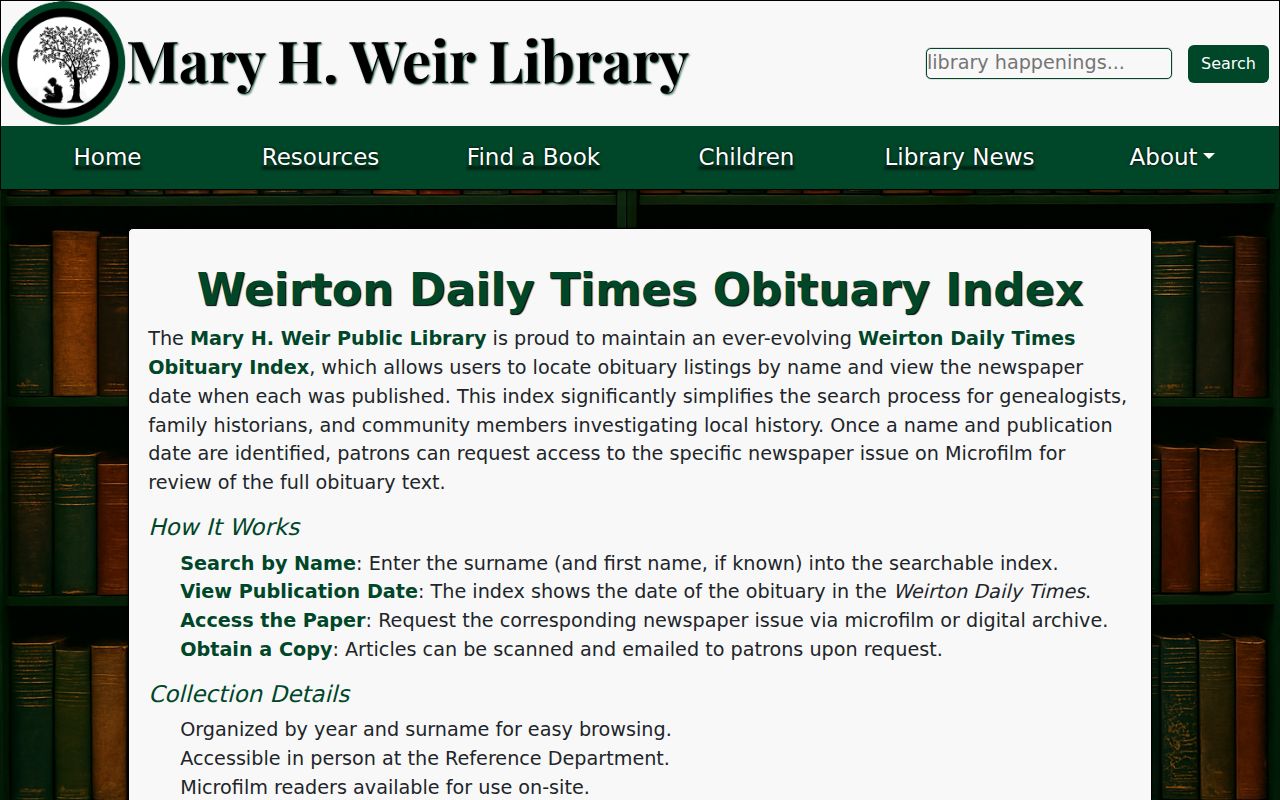
The Mary H. Weir Library's obituary index searches surname and first name and returns the publication date. Staff can use the digital microfilm reader to make an issue copy and email it. The index is evolving, and its complete date span was not located, so try spelling variants and ask about issues outside the visible results.
The Weirton obituary index provides that date-first route:
The Library of Congress catalogs the Weirton Daily Times from 1928 to the present. News items may document a move, death, sale, fire, permit, public meeting, or family event at a date between directory and census snapshots.
Add Weirton Permit Context
The current city building-permit form collects work location, address, tax map, parcel, owner, contractor and license information, project description, and certifications. A permit can date physical work and tie it to named project roles. No public historical permit index or exact year run was found, so request a defined address and date range from the city rather than assuming online completeness.
Sanborn fire-insurance maps can sometimes show building footprints and construction context, but exact official Weirton sheets were not confirmed. Leads for 1915, 1919, and 1923 must not be presented as verified coverage until a Library of Congress catalog record and sheets are inspected. The correct fallback is to search by state, city, and edition date, then record the sheet count and notes. Museum photographs, planning maps, sanitary-board records, and newspapers may fill other physical-history gaps.
Build Weirton Household Evidence
Ownership is only half the question about previous residents. Pair a directory entry with the closest census snapshot, then compare the household names, ages, relationships, and place labels that the original record supplies. Mary H. Weir Library reports census material, but the research did not locate an exact local page inventory. Confirm access before expecting a specific image.
- Anchor the parcel and deed chain first.
- Find a directory entry close to the target year.
- Check the nearest available census for the person and place.
- Use the obituary index and newspaper issue to close a death or departure trail.
- Check probate, cemetery, and lawful vital sources when the evidence calls for them.
Weirton's 1947 incorporation joined older communities including Hollidays Cove, Weirton Heights, and Marland Heights. Search those labels as well as Weirton, then retain the source's original wording. No official street-renumbering conversion table was located, so a house-number mismatch belongs in the research log, not in a guessed match.
Lawful use. Research previous residents for family or house history, and never use a record trail to stalk, harass, or expose a living person.
Cite Every Weirton Address Link
For each step, record the source title, office or collection, county, date retrieved, record date, exact spelling, PID, legal description, book/page, directory edition and page, and whether you saw an index, image, transcript, or certified copy. Keep your interpretation in a separate note. That distinction lets another researcher test the same claim.
State the gaps as clearly as the finds. Current Hancock portal coverage, a Brooke clerk portal, historical permit coverage, exact Sanborn editions, directory publishers, and reverse-page availability remain unresolved. Previous residents cannot be assigned exact arrival or departure dates without dated evidence. A careful timeline may have blank years, and those blanks are more honest than an invented continuous list.